
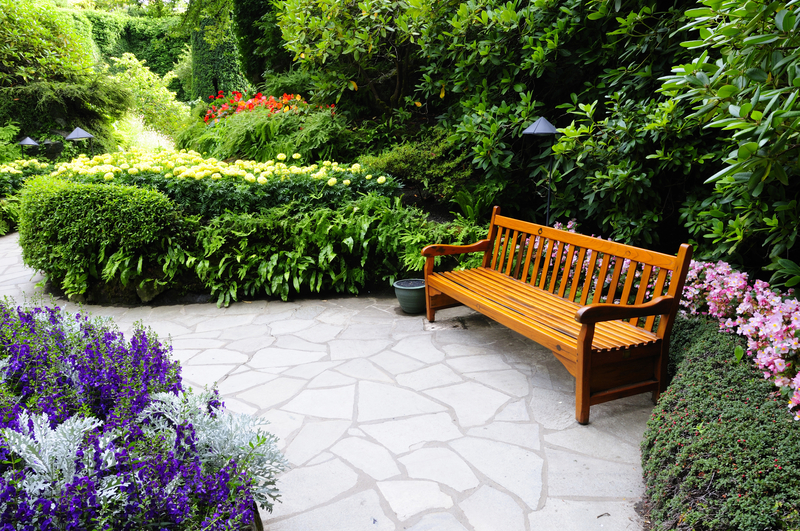
A £180 bench and a £600 bench can look almost identical in a photograph. The difference shows up after two British winters, in the joints, the legs and the fixings of the garden bench.
Choosing the right wooden garden bench is about matching the timber, the size, where the bench sits, and how much upkeep you are prepared to do. Get those right, and a timber bench will outlast most of the furniture around it.
What Makes a Wooden Garden Bench Suitable for British Weather?
Three factors contribute to making a garden bench suitable for British weather.
- Timber treated to resist fungal decay
- Fixings that will not corrode
- Design that lets water drain away instead of pooling.
Rain on its own does very little damage. The problem is prolonged damp with nowhere to go. Water that sits in a flat seat, in the end grain of a leg, or in the gap between two badly fitted slats is what starts the rot.
Frost makes it worse. Trapped moisture expands as it freezes, opening up small splits that let in more water the following season. That cycle, repeated over four or five winters, is what pulls a cheap bench apart.
UV is the least serious of the three. Sunlight greys the surface of untreated timber but does not weaken it. If you like the silvered look, leave it. If you do not, a coat of treatment restores the colour.
Check for:
- Pressure-treated or naturally durable timber
- Galvanised or stainless steel screws and bolts
- Slatted seat with drainage gaps, not a solid flat surface
- Wide, flat feet rather than raw cut ends
- Sealed or treated end grain
Which Timber Is Best for a Wooden Garden Bench?
Pressure-treated softwood is the right choice for most British gardens. It offers the best balance of durability, price and availability, and copes with damp far better than untreated timber of the same thickness.
Pressure-treated softwood
Preservative is forced into the timber under pressure, so protection runs deeper than the surface rather than sitting on top of it. That is why a treated softwood bench holds up in a way a painted untreated one does not. Expect 10 to 15 years with a re-coat every year or two.
Oak
Oak contains natural tannins that resist decay without any chemical treatment. Left alone, it weathers to a soft silver-grey. It is heavy, expensive and worth it if you want a bench that becomes a permanent part of the garden rather than a piece of furniture you replace.
Railway sleepers
Sleeper benches are built from timber sections far thicker than anything used in standard garden furniture. That mass is the point. They shrug off weather, they do not blow over, and they suit a rustic or sloping plot where a lighter bench would look lost.
| Timber | Typical lifespan | Maintenance | Best for |
| Pressure-treated softwood | 10 – 15 years with care | Re-treat every 1 – 2 years | Most gardens, patios, family use |
| Oak | 20+ years | Oil annually, or leave to silver | Traditional gardens, permanent features |
| Railway sleeper | 20+ years | Very low | Rustic plots, heavy-duty and feature seating |
Browse the range
Wilfirs supplies softwood benches, country-style benches, carver seats, oak benches and railway sleeper seating from our Coventry yard.
See the garden seats and benches range.
What Size Garden Bench Should You Buy?
Measure the space first, then work backwards. A 5ft bench seats three adults. A 4ft bench seats two. A single carver takes around 700mm of width and works where a full bench would crowd the space.
Allow 600mm of clear floor in front of the bench for legs. People forget this and end up with seating nobody uses because you cannot get past it.
| Your space | Recommended seating | Approximate width |
| Small patio or courtyard | Single carver, or a pair | 700mm each |
| Front garden or narrow border | 4ft two seater | 1.2m |
| Standard back garden | 5ft bench | 1.5m |
| Entertaining and family use | 5ft bench plus carver seats | 1.5m and above |
| Memorial or feature seating | 5ft engraved bench | 1.5m and above |
Two carvers often beat one bench in a small garden. They can be moved apart for sun, pulled together for company, and they leave the space feeling open.
Which Garden Bench Style Suits Your Outdoor Space?
Match the bench to what is already in the garden, usually the fencing and the hard landscaping. A bench that clashes with the fence line reads as an afterthought, however good it is.
- Cottage and traditional gardens. A country-style bench with a shaped back and heavier timber sections sits naturally against planting.
- Modern patios and decking. Straight lines and a lower back keep sightlines open. Pair timber seating with decking in a similar tone.
- Rustic or sloping plots. Sleeper benches suit gardens with retaining walls, gravel and mature planting.
- Under a structure. A high-back bench beneath a pergola or wooden rose arch becomes the focal point of the garden rather than somewhere to sit.
- Memorial seating. A stained and engraved bench in a durable timber, positioned somewhere with a view worth sitting for.
Picture where the bench will be seen from as well as where it will be used. A bench framed by planters or set against a gazebo earns its place from the kitchen window too.
What Should You Check Before Buying a Wooden Bench?
Five things, in this order.
- Timber thickness: Seat slats under 25mm flex under weight and cup as they dry. Look for 30mm or more.
- Joints: Bolted or mortised joints hold. Screws driven straight into end grain work loose within a couple of seasons, and end grain is where timber is weakest.
- Fixings: Galvanised or stainless steel. Ordinary steel rusts, and rust running down a timber leg stains it permanently.
- Comfort: Seat height around 450mm, seat depth 400 to 450mm, and a backrest that leans back rather than standing vertical. Most people notice the back angle within ten seconds of sitting down.
- Weight: A bench light enough for one person to carry easily is light enough for a gale to move.
Buying checklist
- Seat slats 30mm or thicker
- Bolted or mortised joints
- Galvanised or stainless fixings
- Seat height around 450mm, back angled
- Heavy enough to stay put in wind
- Individual slats can be replaced
- Timber pressure treated, or naturally durable
Not sure which suits your garden?
The Wilfirs team can talk through sizes and timber before you order.
Get in touch for advice or a quote.
How Much Maintenance Does a Wooden Garden Bench Need?
One clean in spring and one coat of treatment in autumn. That is around an hour a year for a softwood bench, and less for oak.
| Season | What to do |
| Spring | Wash down with warm soapy water and a soft brush. Check and tighten every fixing. |
| Summer | Nothing beyond a wipe and a look at the joints. |
| Autumn | Pick a dry spell and re-coat with a timber preservative or oil. |
| Winter | Keep fallen leaves off the seat. Tip the bench forward or cover it if the spot is exposed. |
Skip the pressure washer. It strips the soft fibres out of the grain and leaves a rougher surface that holds water, which is the opposite of what you want.
Common Mistakes to Avoid
- Buying on appearance alone: A photograph shows the shape, not the joint type or the timber thickness.
- Assuming treated means maintenance-free: Treatment slows decay. It does not stop it.
- Choosing the wrong size: A 5ft bench in a courtyard blocks the route to the back door.
- Standing it on wet grass: The single fastest way to lose the legs.
- Buying flat-pack with thin fixings: Weak hardware fails long before the timber does.
- Leaving it uncovered and untreated through a first winter: The damage starts in year one, even though it shows in year three.
Key Takeaways
- Pressure-treated softwood suits most British gardens. It handles damp well, costs less, and needs a re-coat every year or two.
- Choose oak or railway sleeper construction if you want a heavy, permanent feature and can accept the higher price.
- A single carver seat or 4ft bench fits patios and front gardens. A 5ft bench seats three adults comfortably.
- Look for galvanised or stainless steel fixings and seat slats at least 30mm thick.
- Stand the bench on paving, slabs or gravel. Legs sitting in wet soil are the most common reason a bench fails early.
- Budget for one clean and one re-treat a year. That is roughly an hour of work.
Choosing the Right Bench, in One Paragraph
If you want low cost and low fuss, buy pressure-treated softwood and re-coat it each autumn.
If you want a bench that outlives the fence around it, buy oak or sleeper. If your space is tight, buy carver seats instead of a bench. If you are furnishing for family and guests, buy 5ft. Whatever you choose, stand it on something hard and dry.
Browse Wilfirs’ garden seats and benches to see the current range of softwood, oak, country style and railway sleeper seating, all built for British gardens and available for collection or delivery.
Call us on 0800 0190 316 or 02476466313 to get in touch with our experts to get the best suggestion for your garden bench that withstands the British weather.
