
To measure fence panels correctly, measure your total fence line in metres, divide by the panel width (usually 1.8 m), and round up. Subtract any gate widths before dividing. That gives you your panel count, and adding one more gives you your post count.
Incorrect measurements lead to wasted materials, uneven spacing, and an unstable fence that looks poor and performs worse. This guide walks you through how to measure your garden boundary correctly, calculate the number of panels you need, and plan for gates, slopes, and corners so that you can buy with confidence.
How do you measure a fence line?
Walk the boundary and measure each straight section separately with a long tape measure or measuring wheel. Record every section before moving on.
- Start at one corner of the garden or property boundary.
- Measure the full length of each side.
- Record each section length before moving to the next.
- Add all section lengths together for your total fence line.
Tip: Measure in metres throughout. Mixing metres and feet mid-calculation is one of the most common sources of error.
What is the standard fence panel width in the UK?
Most UK fence panels are 6 ft wide, which is 1.83 m, usually rounded to 1.8 m for calculation purposes.
Standard heights are 3 ft, 4 ft, 5 ft, and 6 ft. The 6 ft height is most common for garden privacy.
Always confirm the exact width of the panels you are buying before calculating post positions. Even a difference of a few centimetres from 1.8 m will affect whether panels fit cleanly between posts.
Step-by-Step Guide to Measuring for Fence Panels
Follow these steps for the most accurate results. Skipping ahead or measuring out of sequence is one of the most common causes of installation errors.
Step 1: Measure the Total Fence Line
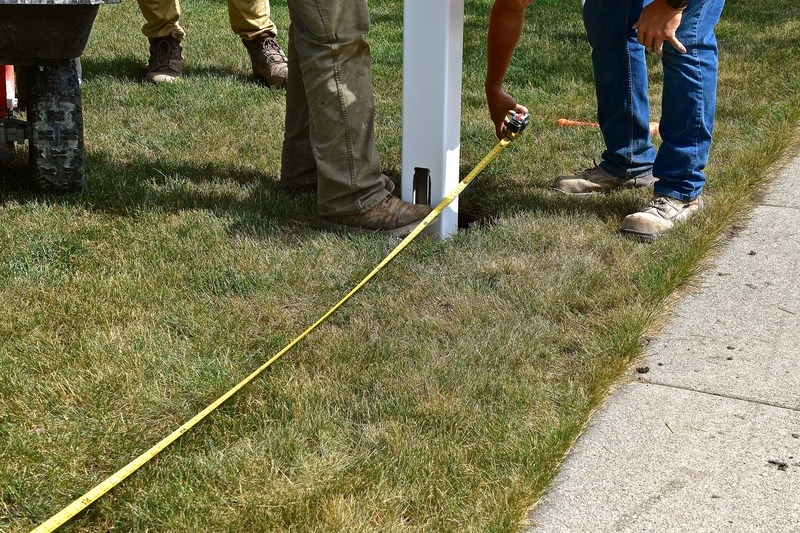
Start by measuring the full length of the boundary where your fence will be installed. Walk the entire perimeter, not just one side, and record the measurement for every section separately.
- Begin at one corner of your garden or property boundary.
- Measure the full length of each side using a tape measure or measuring wheel.
- Record each section measurement before moving on.
- Double-check every measurement before moving to the next step.
Measure consistently in either metres or feet throughout; mixing units leads to calculation errors. This total length forms the basis for all panel and post calculations.
Step 2: Identify the Standard Fence Panel Width
Fence panels are manufactured in standard widths, which directly determines how many panels your fence line requires and how far apart your posts should be.
In the UK, the most common fence panel width is 6 ft (1.83 m). Standard heights include 3 ft, 4 ft, 5 ft, and 6 ft, with 6 ft being the most popular for garden privacy.
Check the exact width of the panels you intend to buy before calculating post positions. Even a small variation from 1.83 m can create gaps or force panels to be cut.
Step 3: Mark Fence Post Positions
Fence panels sit between posts, so post spacing must match the panel width precisely. If posts are placed even slightly too far apart, panels will sag, shift, or fail to fit at all.
- Place a stake at your starting corner.
- Measure the panel width (typically 1.8 m) from that point along the fence line.
- Mark the next post position with a stake.
- Continue this process along the full fence line.
- Run a string line between stakes to confirm alignment.
The string line is a quick and effective way to spot any kinks or deviations before installation begins.
Step 4: Calculate How Many Fence Panels You Need
Once you have the total fence length, the calculation is straightforward:
Total fence length ÷ panel width = number of panels required
Example:
- Fence length: 24 m
- Panel width: 1.8 m
- 24 ÷ 1.8 = 13.33
- Round up to 14 panels
Always round up, not down. A fractional panel count means your fence line requires a partial panel; rounding down leaves a gap.
Step 5: Account for Gates and Openings
Gates take up space that fence panels do not. Before calculating panel numbers, subtract the width of any gates or access openings from your total fence length.
Example:
- Total fence length: 24 m
- Gate width: 1 m
- Adjusted fence length: 24 – 1 = 23 m
- 23 ÷ 1.8 = 12.7 – round up to 13 panels
Also factor in that gate posts need to be positioned and secured independently; these are separate from standard fence posts.
Step 6: Measuring Fence Panels for Sloped or Uneven Ground
Sloped gardens require additional planning. Standard fence panels are rectangular, so they won’t naturally follow a gradient without adjustment. There are two main approaches:
Stepped fencing:
Each panel remains level, but the overall fence steps down in stages following the slope. This is the most common approach for gentle gradients.
Racked fencing:
The panel follows the angle of the ground, which requires specifically designed panels or custom cutting. This is more suitable for steeper or consistent slopes.
When measuring sloped ground, always measure the distance along the slope itself, not just the horizontal distance. This ensures your post spacing and panel count reflect the actual ground being fenced.
Step 7: Double-Check Alignment and Spacing
Before ordering panels or digging post holes, run a final check across all your measurements. Confirm that:
- Post spacing is consistent along the full fence line
- The fence line runs straight (check with your string line or a laser level)
- Gate openings are the correct width for the gate you plan to install
- All measurements have been recorded accurately before purchase
This final check takes only a few minutes but can prevent costly mistakes once installation begins.
How do you choose the right fence panel size?
Your measurements tell you how many panels you need. These four questions help you choose which panels to buy:
- How much privacy do you need? 6 ft solid panels give full coverage. Lower heights or open-top styles suit decorative boundaries.
- Are there height restrictions? Check whether local planning rules limit fence height, particularly at front boundaries and near roads.
- How exposed is the garden to wind? Solid tall panels catch significant wind. Slatted or lattice-top designs reduce the load on posts and footings.
- What durability do you need? Pressure-treated timber panels resist moisture and rot, reducing long-term maintenance.
Get the right fence panels from Wilfirs
Wilfirs stocks a wide range of durable wooden fence panels and gates, built to perform across the full range of UK weather conditions and available in multiple sizes and styles.
Whether you are replacing existing panels or fencing a garden from scratch, the Wilfirs range is designed to deliver reliable security, genuine privacy, and long-term durability.
If you are unsure which panel suits your measurements or garden layout, feel free to get in touch with Wilfirs. You can reach us by phone at 0800 0190 316 or 024 7646 6313, or visit our website to request a free quote or browse our full product range.
